Did you know that when a cat rubs its cheeks against everything it finds, it is actually communicating with you?

What this behavior means and why it is so important in the feline world.

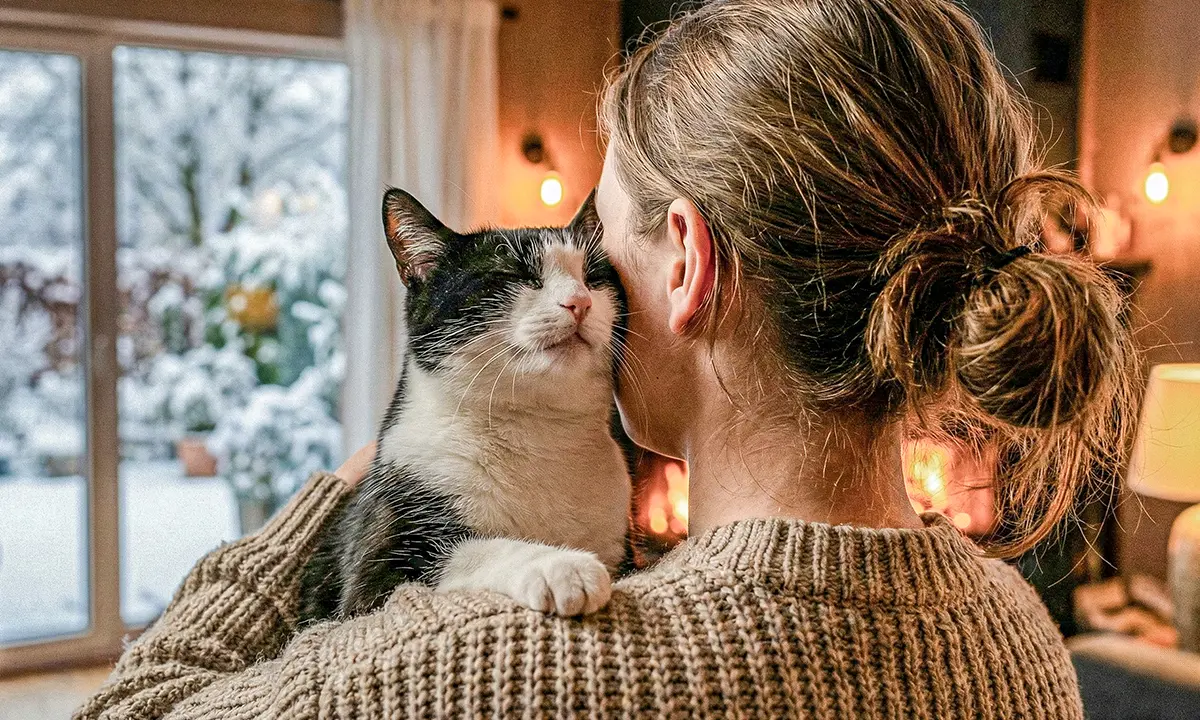
If you have noticed that your cat rubs its cheeks against furniture, corners, doors, your legs, or even other animals, know that this gesture is not accidental. For cats, cheek rubbing against objects is one of the most important forms of communication. This is how they express emotions, safety, and belonging to the space they live in.
Green Cats obrajii pisicii

The cat rubs its cheeks to leave pheromones on objects

On their cheeks and the sides of their heads, cats have scent glands that produce pheromones — substances imperceptible to us, but essential for communication between cats.

When rubbing its cheeks against an object, the cat leaves its pheromones there, saying in its own way: “This place belongs to me. I feel safe here.

For the cat, the environment thus becomes predictable, familiar, and soothing.

When it rubs its cheeks against you, it shows trust

Touching its cheeks against your legs or hands is a deeply affectionate gesture. Through this behavior, the cat mixes its scent with yours and includes you in its “social group”.

In feline language, this means: “You are part of my family. I feel safe with you.”

Sometimes, after doing this, it looks at you, purrs, or turns around for more petting — a clear sign of affection and attachment.

It also rubs its cheeks to attract attention

This gesture can also act as a way to “whisper” something to you:

  • That it wants interaction;
  • That it enjoys your presence;
  • That it wants you to follow it to a certain place;
  • That it is mealtime and it wants to politely remind you.

Cats communicate subtly, and cheek rubbing is one of the most elegant ways they ask for something.

Cheek rubbing is the cat’s way of saying: “Here is my home. You are my family.”

To us, it seems like a small gesture, but for them, it is a complete language — a combination of safety, belonging, affection, and territorial communication. Next time your cat rubs its cheeks against you, know that you are receiving one of the most sincere gestures of trust it can offer.

When the behavior becomes excessive

Although normal, if the cat rubs its cheeks against objects in a very repetitive or agitated way, it may be a sign that:

  • The environment is too stimulating or stressful;
  • It feels insecure;
  • It is trying to regain control over the territory;
  • There is a local dermatological problem.

In such cases, a veterinary or behavioral evaluation may be useful.
What can we do if the problem is veterinary?

  • Rapid veterinary consultation
    The vet can check teeth, gums, skin, and ears — all are areas that can cause discomfort and trigger excessive rubbing.

  • Excluding dental problems
    Toothache or gum inflammation are extremely common and can cause the cat to repeatedly rub its head against objects.

  • Checking skin and ears
    Irritations, insect bites, dermatitis, or ear mites can cause itching or pressure.

  • Appropriate treatment
    Once the cause is identified, treatment is usually simple: anti-inflammatories, oral gels, cleaning, dietary changes, or specific medication.

  • Gentle monitoring
    After treatment, we watch the behavior to see if it returns to normal.

If the rubbing is caused by pain, the treatment completely resolves the behavior.

How do we help if the problem is behavioral?

If the doctor excludes a physical cause, then the behavior is most likely related to stress, the need for safety, or territorial over-marking.

In such cases, help comes through adjustments in environment and routine:

  • Stability and predictability
    Cats need a regular schedule: meals at similar times, play sessions, a calm environment.

  • Reducing stressors
    Loud noises, unknown people, frequent changes in the house, new animals — all can stimulate excessive rubbing.

  • Environmental enrichment
    Climbing spaces, hiding spots, windows for observation, interactive toys, food puzzles.

  • Synthetic pheromones (Feliway)
    These mimic the cat’s facial pheromones and help it feel safe, reducing the need to mark excessively.

  • Quality interaction
    Short, regular sessions of play and petting strengthen the feeling of comfort.

  • Avoiding punishment
    Excessive rubbing is not corrected by “No!” or by pushing away; punishments increase anxiety and intensify the problem.

  • Professional behavioral consultation
    If the stress is severe or manifests through urinary marking, aggression, or other behaviors, consulting a feline specialist can make the difference.

Conclusion

Whether it is a physical or emotional problem, the cat is always showing us something — our role is just to listen.


    Green Cats
    Green Cats

    Together we make the world a better place, one cat at a time!

    Green Cats is a non-governmental organisation, founded in 2020, dedicated to animal protection, with a primary focus on the protection of cats.

      Cluj-Napoca, Romania


    Programmes


    Get Involved!

    • Traits of a Green volunteer
    • What can you do as a volunteer?
    • How can you become a volunteer?
    • How to become a fosterer?
    • What should you know before becoming a fosterer?
    • Why become a fosterer?
    • How to adopt a cat?
    • What should you know before adopting?

    About Us


    Donate instantly by card

    Donate by bank transfer

    Name

    Asociația Green Cats

    IBAN RON

    RO61BTRLRONCRT0594209501

    IBAN EURO

    RO11BTRLEURCRT0594209501

    Donate with Stripe/PayPal/Patreon

    Redirect or sponsor

    Individuals

    Legal entities

    Help with Galantom

    Donate food

    Asociația Green Cats / Pisicile Verzi

    Pompiliu Ștefu 40, Voluntari, Ilfov | CRN 43119243 | Place of operation: Cluj-Napoca