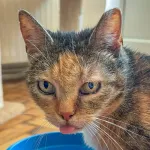
Did you know that even a feral cat can adapt to life indoors if guided with gentleness and patience?
How to help an unsocialized cat discover the safety of a home.
Feral cats or those raised in the wild, without real human contact, are often considered ‘impossible to tame’. In reality, most can learn to feel safe indoors, accept touch, and even seek affection — but their pace is unique. With small, consistent steps and lots of patience, the transformation can be extraordinary.
Create a small and safe space
Adaptation begins in a confined space, not the whole house. A quiet room where the cat has a litter box, food, water, and a few hiding spots (a box, a bed, a low shelf) helps enormously. The small space reduces anxiety and gives it control over the environment, which is essential for a scared cat.
Calm presence works wonders
The first days are dedicated to getting used to human presence. No forced approaches, no attempts to touch. Sit in the room, read, speak softly — let it learn that the human does not represent a danger. This is how trust begins.
Food — your most effective tool
Food creates a strong positive association. At first, the cat will eat only when you are not there. Then it will eat in your presence, and over time it will get closer and closer. You can gradually shorten the distance between you and the bowl, letting the cat dictate the pace.
Play — the first real step toward relaxation
A wand or a long toy can help it relax in your presence without feeling exposed. Play is one of the safest ways for cats to start expressing themselves naturally and approaching humans.
Let it make the first move
Feral cats need to take control of their own adaptation process. Do not touch it until it comes to you. You will notice small signs of progress: it comes out of hiding more often, stays in plain sight, blinks slowly, stretches relaxed in your presence. These are its steps, and you just provide the right framework.
Learn the language of a scared cat
Hissing, swatting, staying flat to the floor, or hiding are not ‘aggression’, but fear. Over time, these reactions transform into much gentler ones. Slow blinking, voluntary approach, or playing in your presence indicate that the process is working.
Adapting to touch and handling (essential for the vet)
For a feral cat, touch is a huge step. Start by approaching your hand slowly, without touching it. Allow it to smell it and withdraw. Repeat. Initial touches should be short, on the cheeks or forehead, areas where cats tolerate contact best.
Later, get it accustomed to the carrier: leave it in the room, put familiar blankets in it, feed it at the entrance. This makes vet visits much easier.
Adapting to other cats
Feral cats can coexist with other cats, but they must never be introduced directly. The process must be gradual and only after complete acceptance of the human:
- Start with scent swapping (blankets, towels);
- Then allow them to observe each other through a cracked door or mesh;
- Short, supervised meetings come only when both are relaxed.
Sudden interactions can cause major regression — that is why the pace must be slow and very controlled.
Remind yourself: any cat can succeed
There are no ‘lost’ cats, only cats that need more time. I have seen cats that stayed under the bed for three months and now ask for pets. I have seen cats that couldn’t be touched and now sleep on their human’s chest. Adaptation is possible — if their pace is respected.
Why it’s worth all the effort
The moment a feral cat comes towards you for the first time, touches you with its nose, or purrs — is one of the most profound gifts an animal can offer. Trust earned, not given from the start, has a unique beauty.
Conclusion
Feral cats are not ‘impossible cases’. They are just cats that have not yet known the safety of a home. With gentleness, space, consistency, and patience, almost any cat can come to live peacefully and beautifully indoors — and even become a surprisingly affectionate companion.