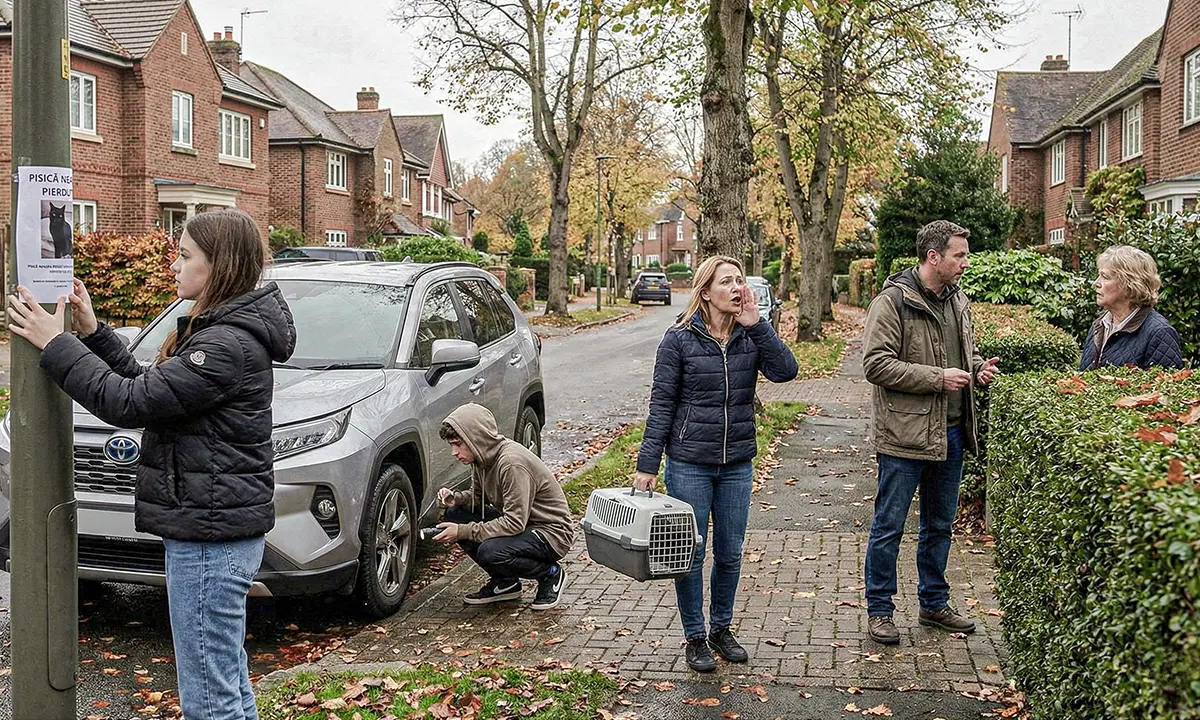
Did you know that the first 24 hours are essential if a cat gets lost?
1. Search immediately in the nearby area — cats do not run far
Contrary to myths, cats do not run for miles. If they are lost:
- Indoor cats usually stay within 10–50 meters of the disappearance site.
- Outdoor cats may move a bit further, but still tend to stay nearby.
The reason? They hide immediately, in a dark, hard-to-reach, and very close place.
Most common hiding spots: under cars, in basements, in garages, in gardens and dense bushes, in sheds, under balconies, technical spaces, pipes, open trash chutes.
Search with a flashlight in the evening, at night, and early morning, when cats are more active and their eyes shine in the light.
2. Speak with a calm voice and call it by name
Scared cats do not come when called, but the owner’s voice can make them move or make a sound. This helps you locate it. Say its name quietly, repeatedly, and make familiar sounds (wet food can, pouch, or treats).
3. Leave objects out with your scent and its own
Cats are guided enormously by scent, and a familiar object attracts them toward home. You can leave: worn clothes, its blanket, the litter box (only in safe areas, not in front of the stairs), the carrier.
Familiar scents reduce fear and can guide them back.
4. Notify neighbors and ask for access to enclosed spaces
Most cats cannot get out on their own from the place they enter. Therefore, it is vital to:
- Ask neighbors to check garages, cellars, sheds and keep an eye out – leave your contact phone number;
- Ask for access to basements or technical spaces;
- Post in the apartment building or neighborhood group;
- In apartment buildings, check trash chutes and technical rooms, as well as hallways and more secluded places, such as behind flowers, furniture stored in the hallway, etc.
A trapped cat does not meow constantly — some stay completely silent out of fear.
5. Post well-made ads
Include:
- Clear photos;
- Exact area;
- Large and visible phone number;
- Behavior: „scared / gentle / does not let itself be caught”.
Announce on:
- Local lost animal groups;
- Neighborhood groups;
- At veterinarians;
- On the street, in the area of disappearance.
Do not post on only one group — wide distribution increases the chances.
6. If the cat is skittish, use a capture cage
This is the method used by NGOs and veterinarians. Panicked cats will not let themselves be picked up, even if they are gentle at home.
The cage should be placed:
- In a secluded spot;
- With very smelly food (tuna, sardines, pate);
- And checked frequently.
It works especially at night.
7. Don’t give up too soon
Cats have been recovered after days, weeks, and even years.
Especially indoor ones have a strong „freeze” instinct — they stay hidden until they feel safe.
Perseverance is key. Even if you don’t see it, it is close by.